
Published June 2, 2026 · Reviewed by the Pro Needling editorial team · 8 at-home microneedling tools tested over 6 weeks
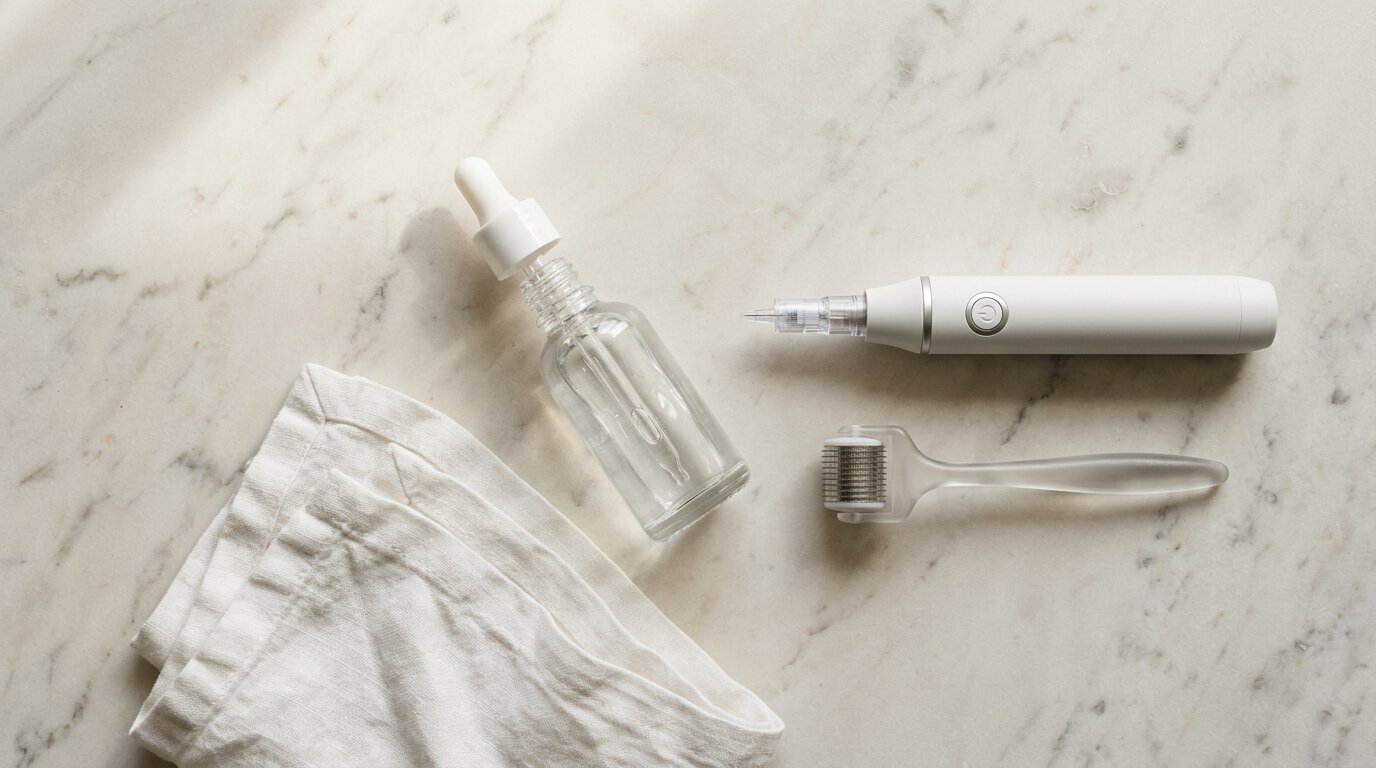
At-home microneedling done right delivers 60-70% of what you’d get from professional treatments at a fraction of the cost. Done wrong, it scars skin permanently. This guide breaks down the 8 best at-home microneedling tools across rollers, pens, and stamps, plus the depth, technique, and aftercare protocol that separates a treatment from an injury.
Top picks:
- Editor’s choice (best overall pen): Dr. Pen M8S ($119), wireless, 22,000 RPM, digital depth display
- Best beginner derma roller: Linduray 0.25mm titanium
- Best at-home stamp (no rolling): Banish Banisher 3.0
- Best advanced at-home: Dr. Pen A11 Ultima Pro
Table of contents
- Why at-home microneedling works (and when it doesn’t)
- Rollers vs pens vs stamps
- Comparison: 8 at-home microneedling tools
- Full reviews
- What depth should you use at home?
- Step-by-step technique
- 5 mistakes that ruin results
- FAQ
Why at-home microneedling works (and when it doesn’t)
The mechanism is identical to professional microneedling: tiny needles create controlled micro-injuries that trigger collagen synthesis. What differs is depth, equipment quality, and aftercare rigor.
At-home microneedling works for:
- Fine lines and early wrinkles
- Brightening and skin tone evening
- Mild hyperpigmentation and dark spots
- Mild acne scarring
- Improved product absorption
- General anti-aging maintenance
At-home microneedling does NOT work for:
- Deep boxcar or ice pick acne scars (require 1.5mm+ depth, professional setting)
- Deep wrinkles requiring filler-level intervention
- Stretch marks at depth (need 1.5-2.5mm in professional setting)
- Severe cystic acne (treat the acne first)
- Active rosacea or eczema flares
Rollers vs pens vs stamps
Three categories of at-home device, three different mechanisms.
Derma rollers: Manual cylinder with needles. Roll across skin in multiple directions. Cheapest entry point ($15-50). Limited to depths under 1.0mm for safety. Wider but shallower puncture pattern than pens.
Derma pens: Battery-powered device with oscillating needle cartridge. Adjustable depth up to 2.5mm (don’t exceed 1.0mm at home). Cleaner, more precise punctures. Best results, higher cost ($80-300).
Derma stamps: Single-position needle stamp pressed straight down. Most precise for targeted treatment of specific spots, scars, or stretch marks. Less efficient for full-face coverage. Banish Banisher 3.0 is the leading example.
Comparison: 8 at-home microneedling tools
| Device | Type | Max depth | Best for | Price tier |
|---|---|---|---|---|
| Dr. Pen M8S | Pen | 2.5mm | Most users, balance pick | $$ |
| Dr. Pen A11 Ultima Pro | Pen | 2.5mm | Advanced users | $$$ |
| Dr. Pen Ultima M8 | Pen | 2.5mm | Proven workhorse | $$ |
| Dr. Pen Ultima A7 | Pen | 2.5mm | Budget beginner | $ |
| Banish Banisher 3.0 | Stamp | 1.0mm | Spot treatment, acne scars | $$ |
| Linduray 0.25mm Titanium Derma Roller | Roller | 0.25mm | Daily use, product absorption | $ |
| Stacked Skincare Daily Face Roller | Roller | 0.2mm | Daily routine inclusion | $$ |
| BeautyBio GloPRO | Pen-roller hybrid | 0.3mm | Gentle treatment + LED | $$$$ |
Full reviews
1. Editor’s choice, Dr. Pen M8S

Best for: The widest range of at-home users | Type: Battery pen | Max depth: 2.5mm
The M8S is the editor’s choice across the at-home category. 22,000 RPM motor delivers cleaner punctures than slower devices. Digital LED depth display removes guesswork. Anti-backflow cartridges are a real hygiene upgrade. Wireless + wired flexibility means you can use it portably or plugged in. For complete review, see our microneedling pen guide.
2. Dr. Pen A11 Ultima Pro
Best for: Advanced at-home users wanting clinical-quality build | Type: Battery pen with inductive charging | Max depth: 2.5mm
The A11 Pro is the upgrade for users who’ve outgrown the M8S. 3-lock cartridge connection (no wobble at high RPM), inductive charging stand, premium build. Approaches professional-tier pricing but stays within consumer category.
3. Banish Banisher 3.0 (stamp)
Best for: Targeted treatment of acne scars, dark spots, stretch marks | Type: Manual stamp | Max depth: 1.0mm
Stamps deliver pressure straight down rather than rolling, cleaner punctures, less skin tearing. Banisher 3.0 is the leading at-home stamp, particularly strong for spot-treating acne scars on cheeks and chin. Pairs with their broader Banish acne ecosystem (cleansers, serums) for a complete acne-scar protocol.
4. Linduray 0.25mm Titanium Derma Roller
Best for: Daily product absorption, beginner introduction | Type: Manual roller | Max depth: 0.25mm
0.25mm is too shallow for real collagen induction but ideal for daily product absorption enhancement. Roll before applying hyaluronic acid, peptides, or growth factor serums to drive them 4-5x deeper than topical application alone. Safe for daily use because depth is below dermis level.
5. Stacked Skincare Daily Face Roller (0.2mm)
Best for: Routine inclusion, sensitive skin | Type: Manual roller | Max depth: 0.2mm
Even gentler than the Linduray. The 0.2mm depth is purely for product absorption, won’t trigger meaningful collagen response, but won’t cause irritation either. Marketed for daily inclusion in skincare routines.
6. BeautyBio GloPRO
Best for: Combined microneedling + LED therapy, gentle users | Type: Pen-roller hybrid with red LED | Max depth: 0.3mm
GloPRO combines microneedling with red LED light therapy in one device. Lower max depth (0.3mm) means it’s for product absorption + light therapy, not deep collagen induction. Premium pricing for the LED integration.
7. Dr. Pen Ultima M8

The original M8, workhorse status earned over years of community use. Slightly less powerful than the M8S upgrade but $20-30 cheaper. Strong pick if you want proven reliability over latest features.
No longer sold on AmazonSee it at Dr. Pen’s official US store →
8. Dr. Pen Ultima A7

The budget Dr. Pen entry point. Wired only, lower motor RPM, but same cartridge ecosystem as higher-tier models. Right pick for first-time microneedlers testing commitment before upgrading.
DiscontinuedSee its successor, the A11, at Dr. Pen’s official store →
What depth should you use at home?
For most home users:
- 0.25mm: Daily product absorption, very gentle
- 0.5mm: Fine lines, brightening, start here for real treatment
- 0.75mm: Moderate concerns, every 3 weeks
- 1.0mm: Maximum for at-home use on cheeks/jawline, every 3-4 weeks
Never exceed 1.0mm at home. Anything above requires professional supervision. For complete depth recommendations by area and concern, see our microneedling depth chart.
Step-by-step at-home microneedling technique
- Cleanse thoroughly. Double cleanse if needed. Skin must be makeup, oil, and sunscreen-free.
- Apply numbing cream if treatment depth is 0.5mm or deeper. Cover with cling wrap for 25-30 minutes. See our numbing cream guide.
- Remove numbing cream completely. Wipe with damp cloth, follow with alcohol wipe if available.
- Apply pure hyaluronic acid serum. Use sterile-fill if depth above 0.5mm. See our HA serum guide.
- Treat in sections. Cheeks, forehead, jawline, chin. Roll/stamp/pen in multiple directions per section (vertical, horizontal, diagonal).
- Apply second layer of HA serum immediately after.
- Skip all other products for first 24 hours.
- Daily mineral sunscreen starting day 2. See our sunscreen guide.
5 mistakes that ruin at-home microneedling results
- Going too deep too fast. Beginners jump to 1.0mm “to see results faster” and end up with damaged skin. Start at 0.25-0.5mm.
- Reusing cartridges. Single-use only. Reused cartridges cause infections and tear skin with dull needles.
- Treating too frequently. 0.5mm every 2 weeks. 1.0mm every 3-4 weeks. Overlapping sessions interrupts collagen synthesis.
- Skipping sunscreen. #1 cause of post-treatment hyperpigmentation. Mineral SPF 30+ daily for at least 14 days.
- Using actives during recovery. No retinoids, AHAs, BHAs, or vitamin C for 7-14 days post-treatment. See our aftercare guide.
FAQ
Is at-home microneedling worth it?
For fine lines, brightening, hyperpigmentation, and mild scarring, yes, at-home microneedling delivers real results at 5-10% the cost of professional treatments. For deep scarring or stretch marks, professional treatment is required because the necessary depths (1.5mm+) aren’t safe at home.
What’s the best at-home microneedling device?
The Dr. Pen M8S ($119) is the best balance of features, power, and price for most at-home users. For advanced users, the Dr. Pen A11 Ultima Pro ($219). For spot treatment of acne scars, the Banish Banisher 3.0 stamp. For daily product absorption, the Linduray 0.25mm derma roller.
How deep should I microneedle at home?
Never exceed 1.0mm at home. Start at 0.25-0.5mm to assess tolerance, then move up to 0.75-1.0mm for ongoing treatment if needed. Anything above 1.0mm requires professional supervision due to infection and scarring risk.
How often can I microneedle at home?
At 0.25mm: 1-2x per week. At 0.5mm: every 2 weeks. At 0.75mm: every 3 weeks. At 1.0mm: every 3-4 weeks. Skipping recovery time interrupts collagen synthesis and reduces results.
Can I do microneedling at home if I have acne?
Active acne is a contraindication, wait until acne is controlled before microneedling, otherwise you risk spreading bacteria and triggering breakouts. Once controlled, microneedling helps fade acne scars over time.
What should I use during microneedling at home?
Pure hyaluronic acid serum during treatment for glide. Sterile HA if treatment depth is above 0.5mm. After treatment, layer in peptide serums starting day 2 and growth factors starting day 3. See our serum guides for specific picks.
Summary
At-home microneedling works for fine lines, brightening, hyperpigmentation, and mild scarring, not for deep scars or stretch marks. The Dr. Pen M8S is the best all-around device for most users. Cap depth at 1.0mm for safety. Use pure hyaluronic acid during treatment. Apply mineral sunscreen daily after. Avoid actives for 7-14 days.
For complete protocol guidance, see our depth chart, pen reviews, HA serum guide, numbing cream guide, and aftercare.

Kathy is a certified nutrition & health coach, long-time model, and lifelong skincare devotee. After years in the fashion industry, where your skin is your business card, she went deep on what actually works and founded ProNeedling. She tests the tools, treatments, and products we cover.