
By the ProNeedling editorial team · Updated August 2026
Every microneedling provider needs a clear informed-consent form. It protects your clients, your practice, and your insurance position. Below is a free, professionally structured microneedling consent form template you can copy and adapt, plus the complete documentation kit for your whole practice.
What a microneedling consent form must include
- Procedure description and realistic expectations (results vary; a series is usually needed)
- Risks and side effects, from normal redness and flaking to rare infection or scarring
- Contraindication checklist (pregnancy, active infection, keloid history, isotretinoin, and more)
- Medication and product prep (stop retinoids/actives before treatment)
- No-guarantee and non-refundable statements
- Signature, date, and photo/records consent
Free microneedling consent form template
Copy, print, or adapt the template below. For the editable version plus the other five forms every practice needs, see the full kit.
Download the microneedling consent form PDF
One page, print-ready, free. No email required.
Download the free consent form (PDF)
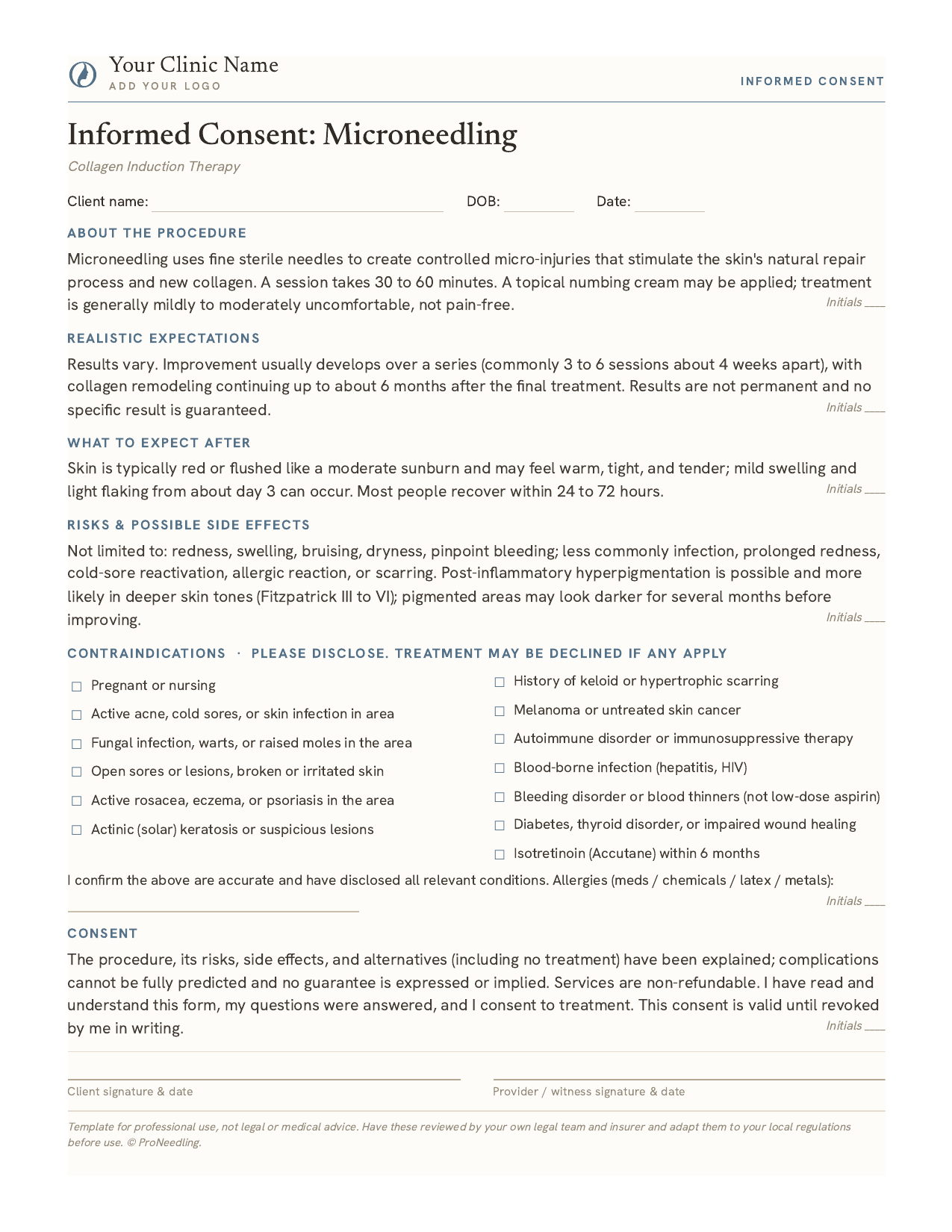
Informed Consent, Microneedling (Collagen Induction Therapy)
Client name: __________ DOB: ________ Date: ________
About the procedure. Microneedling uses fine sterile needles to create controlled micro-injuries that stimulate the skin’s natural repair process and new collagen. A session takes 30 to 60 minutes. A topical numbing cream may be applied; treatment is generally mildly to moderately uncomfortable, not pain-free.
Realistic expectations. Results vary. Improvement usually develops over a series (commonly 3 to 6 sessions about 4 weeks apart), with collagen remodeling continuing up to about 6 months after the final treatment. Results are not permanent and no specific result is guaranteed.
What to expect after. Skin is typically red or flushed like a moderate sunburn and may feel warm, tight, and tender; mild swelling and light flaking from about day 3 can occur. Most people recover within 24 to 72 hours.
Risks and possible side effects (not limited to): redness, swelling, bruising, dryness, pinpoint bleeding; less commonly infection, prolonged redness, hyperpigmentation, cold-sore reactivation, allergic reaction, or scarring.
Contraindications, treatment may be declined if any apply:
- Pregnant or nursing
- Active acne, cold sores, or skin infection in the area
- Open sores/lesions, broken or irritated skin
- Rosacea, eczema, or psoriasis in the area
- History of keloid or hypertrophic scarring
- Melanoma or untreated skin cancer or suspicious moles in the area
- Autoimmune disorder or immunosuppressive therapy
- Bleeding disorder or blood thinners (other than low-dose aspirin)
- Diabetes or impaired wound healing
- Isotretinoin (Accutane) within the past 6 to 12 months
Prep. Discontinue topical retinoids/vitamin A and active acne topicals 3 to 5 days prior; disclose all medications and allergies.
Consent. I have read and understand this form, had the opportunity to ask questions, and consent to treatment as discussed. I understand services are non-refundable. This consent is valid until revoked by me in writing.
Get the complete Microneedling Consent Form Kit
The free consent above is one of six. The full editable kit gives your practice everything, ready to brand:
- Informed Consent
- Client Intake and Health History
- Pre-Treatment Care handout
- Aftercare sheet plus wallet card
- Treatment Record / progress chart
- Photo Consent and Release
$9.95 · instant download · editable in Canva, plus fillable PDF and Word.
Consent forms for other skin treatments
Running more than microneedling? Each treatment needs its own paperwork: RF microneedling & Morpheus8, exosome & PDRN, PRP, and dermarolling consent forms are free too, or get every kit at once in the Advanced Forms Suite. For client handouts after treatment, see the microneedling aftercare guide.
Frequently asked questions
What should a microneedling consent form include?
Procedure description, realistic expectations, risks and side effects, a contraindication checklist, medication/prep guidance, a no-guarantee statement, and signature plus photo/records consent.
Is a consent form legally required for microneedling?
Requirements vary by state and country, but informed consent is standard practice and usually expected by insurers. Have your forms reviewed by an attorney and insurer and adapt to your local rules.
Can I edit this form?
Yes, copy and adapt the free template. The full kit is editable in Canva plus fillable PDF and Word.
Is there a printable PDF version?
Yes. Download the free one-page consent form as a print-ready PDF above, no email required. The paid kit adds fillable PDF, Word, and Canva versions of all six documents.