
At-home users needle every week. Clinics say wait 4 to 6 weeks. Both can be right, because the answer to how often you should microneedle depends on one thing first: how deep your needles go.
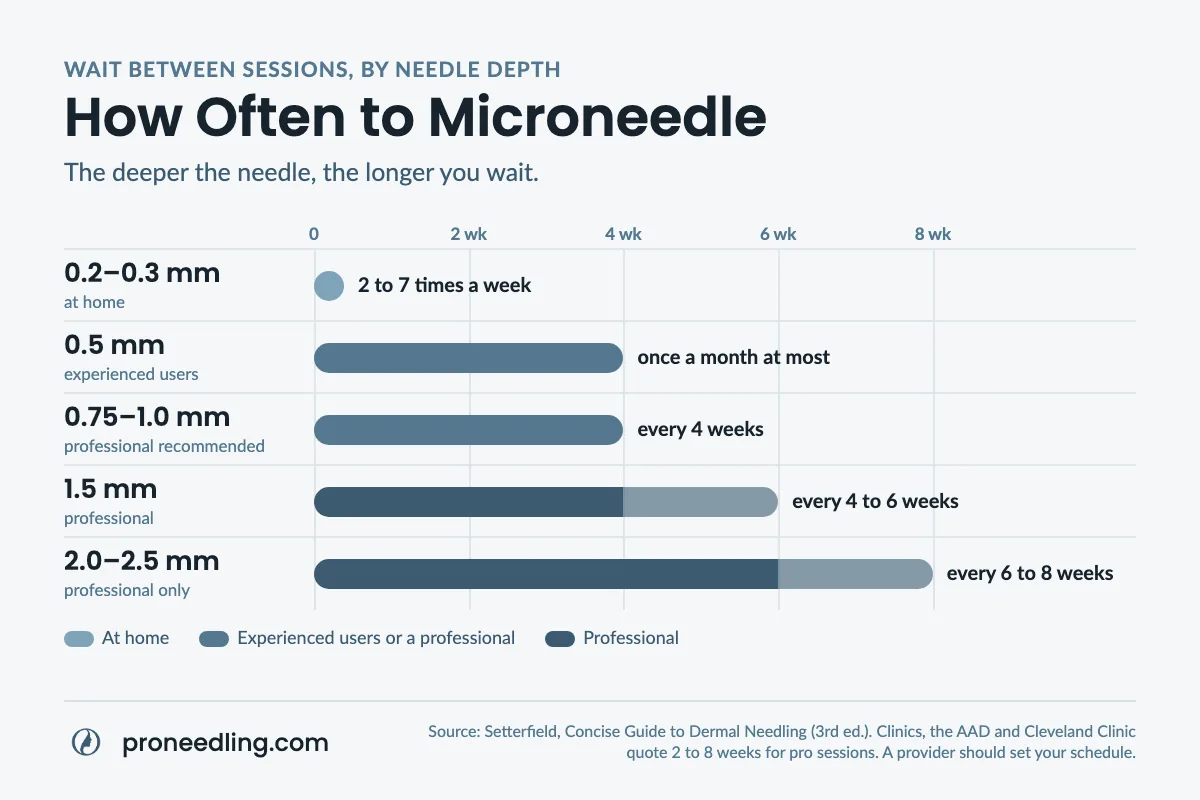
The deeper the needle, the longer you wait. A 0.25 mm derma roller only touches the surface. Once or twice a week is fine, and some people use one daily. At 0.5 mm, wait at least a month. Professional sessions at 1.0 mm and deeper are spaced at least 4 weeks apart, and about 2 months for indented scars. Most concerns take 3 to 6 sessions. After that, the AAD and Cleveland Clinic say a maintenance session about once a year.
How often to microneedle, by needle depth
Needle depth sets your schedule. A deeper needle makes a deeper wound. A deeper wound takes longer to heal and rebuild. This table lines up what the main sources say for each microneedling depth.
| Needle depth | Who usually does it | What it does | How often | What the sources say |
|---|---|---|---|---|
| 0.2 to 0.3 mm | You, at home (roller or pen) | Surface only. Helps products absorb. Little new collagen | 1 to 2 times a week to start. Up to daily once your skin is used to it | Setterfield: 2 to 7 times a week, with daily as the goal at this depth. |
| 0.5 mm | Experienced at-home users, estheticians | Reaches just under the surface. Starts real collagen building | Once a month at most | Dr. Pen’s blog: every 1 to 2 weeks. Setterfield: no more than once a month, because collagenase peaks around day 14 |
| 0.75 to 1.0 mm | A professional is recommended | Fine lines, mild scars, uneven tone | Every 4 weeks | Setterfield: every 28 days for anti-aging |
| 1.5 mm | Professional | Wrinkles, acne scars | Every 4 to 6 weeks | Most clinics quote 4 to 6 weeks. AAD, for acne scars: every 2 to 4 weeks. Cleveland Clinic: 3 to 8 weeks |
| 2.0 to 2.5 mm | Professional only | Deep acne scars, stretch marks | Every 6 to 8 weeks | Setterfield: every 2 months for indented scars |
Swipe the table to see all columns →
Sources: AAD on microneedling, Cleveland Clinic, Dr. Pen, Setterfield, Concise Guide to Dermal Needling, 3rd ed. (chapter on frequency between treatments). A provider should set your exact schedule.
Why you have to wait: your skin’s rebuild timeline
Microneedling makes tiny wounds on purpose. Your skin heals them and lays down new collagen. That rebuild runs on its own clock. Needling again doesn’t speed it up.
- Days 1 to 7: redness and swelling settle. The AAD says these reactions usually clear in a few days to a week.
- Around day 14: Setterfield describes an enzyme that breaks down and reorganizes collagen. It peaks once in the first week and again from about day 14.
- Days 21 to 28: the surface of your skin finishes its normal renewal cycle, according to Setterfield. That’s where his 28-day gap for anti-aging comes from.
- Months 1 to 6: new collagen keeps forming. One study measured more collagen at 1 and 3 months (El-Domyati, 2015). A 480-patient review found a clear rise in collagen 6 months after treatment (Aust, 2008).
- Up to 2 years: the new collagen keeps maturing and lining up, per Setterfield.
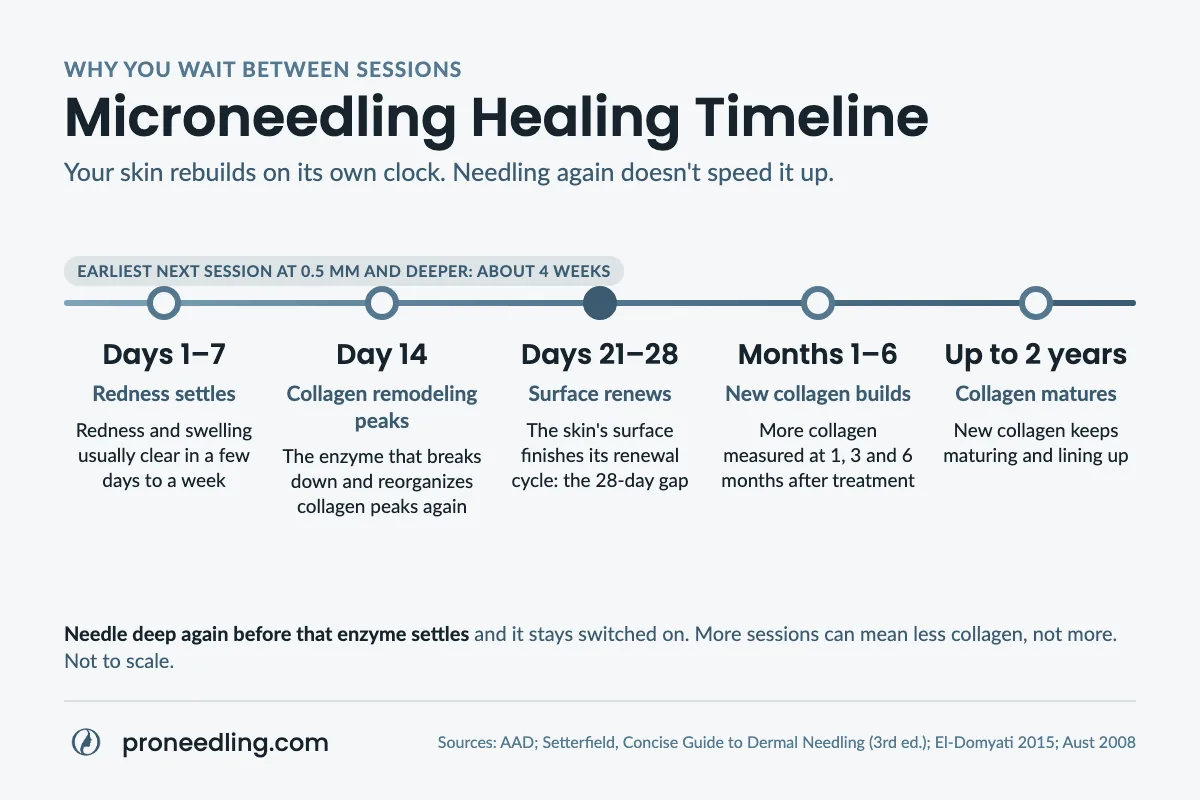
Here’s Setterfield’s case against deep needling every week. That enzyme breaks collagen down. If you needle deep again before it settles, you keep it switched on. So more sessions can mean less collagen, not more. He also points out a trap. Frequent needling makes skin look better at first, because it’s a little swollen. That early plump convinces people that more is better.
Not every source agrees on the exact gap. Several clinical studies spaced sessions just 2 weeks apart and still measured more collagen (El-Domyati, 2015). A 2017 review said the best frequency still needs research (Iriarte, 2017). What every source agrees on: let your skin fully heal before the next deep session. Our microneedling recovery guide covers what that looks like day by day.
- Gap between professional sessions: 2 weeks in several studies, 2 to 4 weeks (AAD, acne scars), 3 to 8 weeks (Cleveland Clinic), 4 to 6 weeks (most clinics), 2 months for indented scars (Setterfield).
- 0.5 mm at home: every 1 to 2 weeks (Dr. Pen), no more than once a month (Setterfield).
- Maintenance: once a year (AAD, Cleveland Clinic) vs every 3 to 6 months (many clinic blogs).
Our read: we follow the intervals in Setterfield’s Concise Guide to Dermal Needling: no more than once a month at 0.5 mm and deeper, and every 2 months for indented scars. Collagenase, the enzyme that breaks down excess collagen, peaks around day 14, so needling more often keeps it switched on. Weekly sessions disrupt the 28-day healing cycle. When in doubt, pick the longer gap. Going slow costs you a few weeks. Going too fast can cost you irritation or dark marks.
Weekly at home vs every 4 to 6 weeks at a clinic: who’s right?
This is the most common argument in microneedling groups. At-home users needle weekly. Professionals say that’s too often. They’re both right, at different depths.
Weekly is fine with a 0.25 mm roller. That depth barely touches the surface. The trouble starts when people take a 0.5 mm or 1.0 mm pen and use it every week. At that depth, you’re making real wounds, and they need the full rebuild window.
The AAD also says at-home products aren’t meant to puncture the skin. They give less noticeable results than a dermatologist can. When a home device does pierce the skin, it can cause infection or scarring. It can also spread warts and cold sores across your face. Pressing too hard can change your skin’s color or texture.
Setterfield’s model is a good middle ground. He suggests one 0.5 mm session a month, ideally supervised, and a cosmetic roller on the days in between. He’s clear that he doesn’t recommend home use at 0.5 mm. If you have a pen set to 0.5 mm or deeper, treat each session like a clinic session: do it once, then wait. Our at-home microneedling guide covers safe depths and tools.
A 0.25 mm roller for the days in between
A cosmetic roller is the tool for the in-between days. The ROSELYNBOUTIQUE derma roller has 540 titanium needles at 0.25 mm. It’s around $7 on Amazon as of Nov 2026, with over 21,000 ratings. At this depth it helps your serum absorb. It won’t treat scars or stretch marks.
Clean it after every use, and never share it. See how to clean a derma roller.
Derma roller vs microneedling pen: does the device change the schedule?
Not really. The depth sets the schedule, not the tool. A 1.0 mm roller and a pen set to 1.0 mm both need at least 4 weeks.
Clinics use medical pens such as SkinPen. One catch with home pens: the number on the dial isn’t always what reaches your skin. Setterfield notes that many electric devices are too weak to reach a set depth of 0.5 mm. A stronger motor gets closer to the depth you pick. Our microneedling pen guide compares motors and depth range, and our Dr. Pen M8 review covers the group’s most-used pen. Some Dr. Pen M8 listings on Amazon US are now sold as 0.25 mm home-use kits, so check the depth before you buy.
For rollers, read how to use a derma roller first. The FDA says never reuse a pen cartridge or use one on more than one person. That can spread infection.
How many microneedling sessions do you need?
Most concerns take a series, not one session. The number depends on what you’re treating and how deep it goes.
| Concern | Typical course | Spacing | Home or pro | What the evidence says |
|---|---|---|---|---|
| Acne scars (indented) | 3 to 6 sessions | About every 2 months (Setterfield). The AAD allows 2 to 4 weeks | Pro | AAD: 3 to 5 treatments every 2 to 4 weeks can fade scars 50% to 70%. One study used 6 sessions 2 weeks apart. Setterfield: every 2 months |
| Stretch marks | 3 to 6 sessions | 4 to 8 weeks | Pro (clinical depth) | 3 sessions 4 weeks apart gave marked to excellent results in 7 of 16 people (Park, 2012) |
| Fine lines and wrinkles | 3 to 6 sessions | Every 4 weeks (28 days) | Pro at 1.0 mm and deeper | 6 sessions 2 weeks apart raised collagen in sun-aged skin (El-Domyati, 2015). Setterfield: every 28 days |
| Hyperpigmentation and melasma | No standard. The main study used 2 | About monthly | Pro only for melasma | 2 sessions 30 days apart at 1.5 mm, with prescription fading cream (Lima, 2015). Studies are small and short |
| Hair loss | Ongoing. Judge it at 12 weeks | Weekly | Pro at 1.5 mm. Ask a dermatologist before home rolling | Weekly sessions plus twice-daily 5% minoxidil beat minoxidil alone at 12 weeks (Dhurat, 2013) |
Swipe the table to see all columns →
Sources: AAD, Park 2012, El-Domyati 2015, Lima 2015, Dhurat 2013, Setterfield, 3rd ed.
Acne scars
For indented acne scars, plan on 3 to 6 sessions. Shallow scars sit at the low end. The AAD says 3 to 5 treatments every 2 to 4 weeks, and that this plan can fade scars by 50% to 70%. The AAD also says adding PRP can be especially effective for acne scars. Raised scars need a different treatment. Read microneedling for acne scars for scar types and a real before and after.
Stretch marks
Stretch marks need clinical depths, so this is a professional job. Plan on 3 to 6 sessions, 4 to 8 weeks apart. In a 2012 pilot, 7 of 16 people saw marked to excellent improvement after 3 sessions. Setterfield warns that stretch marks are the result most likely to disappoint. See microneedling for stretch marks.
Fine lines and wrinkles
The FDA has authorized microneedling devices for facial wrinkles in adults 22 and older. In one study, 6 sessions 2 weeks apart raised collagen in sun-aged skin. Setterfield prefers a 28-day gap for anti-aging. Light home rolling at 0.25 mm can fill the weeks between. For deeper lines, compare other anti-aging treatments.
Hyperpigmentation and melasma
Melasma is the one to be careful with. Too deep or too often can make it worse. The best-known study (Lima, 2015) used just 2 sessions, 30 days apart, with a prescription fading cream and daily sunscreen. Have a dermatologist plan this. See microneedling for melasma and microneedling for hyperpigmentation.
Hair loss
Hair loss is the exception to the long gaps. The main study used weekly sessions at 1.5 mm plus twice-daily 5% minoxidil for 12 weeks (Dhurat, 2013). The AAD lists weekly microneedling plus minoxidil among at-home options, but says to check with a dermatologist first. Setterfield’s hair plan is gentler: 0.3 mm nightly at home and 0.5 mm weekly in a clinic. Read microneedling for hair loss for depth and technique. Beard rolling follows a similar weekly rhythm at shallow depths; see derma rollers for beards.
How often to get maintenance microneedling
Results fade slowly as your body loses collagen with age. The AAD says a dermatologist may suggest one maintenance session a year. Cleveland Clinic says the same. Many clinics quote every 3 to 6 months instead. A course plus upkeep adds up, so check typical microneedling costs first.
So is once a year enough? For most people who finished a full course, yes. If you want more, 2 to 3 sessions a year stays inside what the sources describe. Daily sunscreen helps you keep the collagen you built.
Is it working, or is it getting worse?
Microneedling is slow. The AAD says you may see changes within a few weeks, with full results taking several months. Cleveland Clinic says 3 to 6 months. Setterfield says it takes at least 3 months to see real change, and the change is subtle.
So take a photo every 4 weeks, in the same light and at the same angle. Compare month to month, not day to day. Our guide on why skin can look worse after microneedling explains the early ups and downs. You can also browse real microneedling before and after results.
Normal: redness that feels like a sunburn, tightness, and dry or flaking skin. Cleveland Clinic says swelling can last up to five days.
Call your provider: Cleveland Clinic says to call if the area bleeds for more than 24 hours, blisters, or stays swollen for more than a week.
Stop and get checked: marks getting darker after several sessions. That can be dark marks left behind after irritation (PIH). Stop needling and see a dermatologist before your next session. If you have darker skin, check your Fitzpatrick skin type first. Small breakouts are covered in breakouts after microneedling.
Signs you’re microneedling too often
- Your skin is still pink or tender when the next session is due.
- Products sting that never used to.
- Redness or dryness never fully clears between sessions.
- Skin looks plump right after, then fades. Setterfield says that early plump is swelling, not new collagen.
- New dark patches appear.
Setterfield’s rule for home rolling: if your skin feels sensitive, don’t use the roller again until it feels comfortable. If any of these sound familiar, add time between sessions or drop to a shallower depth. Good microneedling aftercare also shortens recovery. If you’re a provider, our aftercare and consent forms give clients the same rules in writing.
Is it too late to start microneedling in your 50s or 60s?
No. The FDA’s authorization covers adults 22 and older and doesn’t set an upper age. In one study, people with visible sun-aged wrinkles built more collagen after 6 sessions. Setterfield’s book shows patients from 50 to 64 treated with rollers.
What changes with age is speed, not the end result. A review of aging and wound healing found that older skin heals more slowly, but the final result is similar (Gosain and DiPietro, 2004). So give each session the full time to settle. Our depth guide’s advice for 60+ is to go shallower rather than deeper. If loose skin is your main concern, ask about RF microneedling, which adds heat for tightening, or see how microneedling compares with laser.
Who should wait or skip microneedling
The AAD says to skip it if you heal poorly, form keloid scars, have a weakened immune system, or are getting radiation. Wait at least a month after your last isotretinoin pill. Cleveland Clinic says to talk to your provider first if you have active acne, take blood thinners, get cold sores, have eczema or psoriasis, or have moles that change. If you’re pregnant, ask your doctor first. Setterfield notes most products used with microneedling haven’t been tested in pregnancy.
Above 0.5 mm, use a sterile glide, not a multi-use bottle. Our hyaluronic acid for microneedling guide explains sterile vs non-sterile. And read how to prepare for microneedling before your first deep session.
Match your schedule to your depth
Our depth guide has the full chart by skin concern, with depth, recovery time and when to see a professional.
Frequently asked questions
How often should you microneedle at home?
It depends on depth. At 0.25 mm, 1 to 2 times a week to start, up to daily once your skin is used to it. At 0.5 mm, no more than once a month. Deeper than that belongs with a professional. Find one in our provider directory.
Can you microneedle every week?
Only at cosmetic depths of about 0.25 to 0.3 mm. At 0.5 mm and deeper, weekly sessions don’t give your skin time to rebuild. Setterfield argues that can mean less collagen, not more. Hair loss protocols are the main exception, and you should plan those with a dermatologist.
How soon can you microneedle again?
Once your skin has fully healed, and the gap for your depth has passed. That’s at least 4 weeks at 1.0 mm and 4 to 6 weeks at 1.5 mm. If your skin is still pink or tender, wait longer.
How many microneedling sessions do you need?
Most people need 3 to 6. Acne scars, stretch marks and wrinkles usually fall in that range. Cleveland Clinic says results can take 3 to 6 months to show.
Is microneedling once a year worth it?
As maintenance after a full course, yes. The AAD and Cleveland Clinic both describe a yearly maintenance session. A single session a year won’t do much for scars on its own.
How often should you use a derma roller?
A 0.2 to 0.3 mm roller can be used 2 to 7 times a week, per Setterfield. A 0.5 mm roller needs at least a month between uses. A 1.0 mm roller needs at least 4 weeks. See how to use a derma roller.
Can you see a difference after one microneedling session?
Sometimes a little, within a few weeks. Full results take several months and usually a series. Real before and after photos show the timeline. Early plumpness in the first days is often swelling, not new collagen.
Is 50 or 60 too old for microneedling?
No. The FDA’s authorization covers adults 22 and older, with no upper age set. Older skin heals more slowly, so give each session more time to settle. Weigh the pros and cons of microneedling first.
ProNeedling is reader-supported and may earn a commission if you buy through our links, at no extra cost to you. This article is for general information only and is not medical advice. Talk to a qualified provider about your skin before starting any treatment.

Kathy is a certified nutrition & health coach, long-time model, and lifelong skincare devotee. After years in the fashion industry, where your skin is your business card, she went deep on what actually works and founded ProNeedling. She tests the tools, treatments, and products we cover.